Tag: learning

  • Why Teach like a Disney Imagineer?

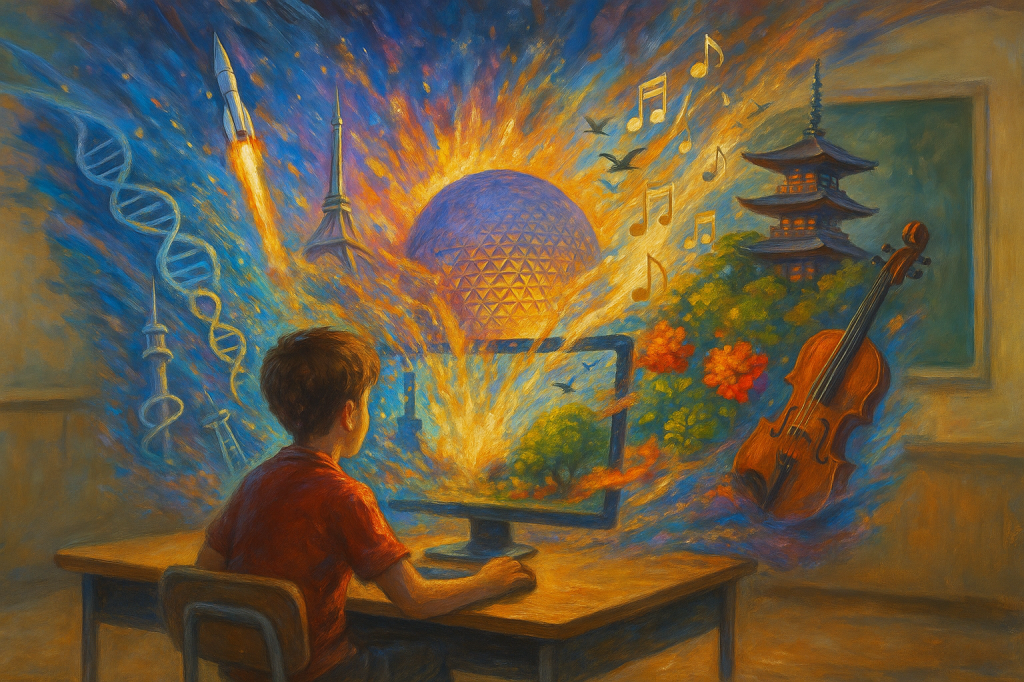
    The Classroom as Immersion

    Today I came across a wonderful quote from former EPCOT show producer Barry Braverman when discussing the creative vision for the park:

    “These stories that we were telling about real stuff, about science, and the future, and about culture, could be as compelling as fantasy stories.”

    Imagineers don’t build rides. They build stories you ride through. If classrooms did the same, students wouldn’t just learn, they’d live their learning.

    One recent trend in education has been the introduction of technology and digital media at earlier grade levels. In many districts, there is even a required quota for how much screen time young students should have. By middle and high school, tasks are completed almost exclusively on Chromebooks or Apple devices. One would assume that by age 15, students would be fluent in tech: creating state-of-the-art presentations, understanding coding basics, and producing digital content with ease.

    And yet! That’s not what I see in my classroom.

    I don’t see Excel wizards or curious digital creators. I see students who’ve mastered shortcuts, leaned on AI, and, frankly, grown complacent. They can click and copy with incredible speed, but ask them why a tool works, or how to make something from scratch, and they stumble.

    So what went wrong?

    We forgot the value of stories.

    When Imagineers create a ride, they start with the story. Every model, every line queue, every sound is designed to immerse. Take the Indiana Jones ride at Disneyland. Logistically, it required a long queue which could’ve felt like a hassle. But instead, the Imagineers turned it into an eerie, ancient corridor full of mystery and suspense. By the time you reach the ride vehicle, you truly believe you’re deep underground. That’s the magic of immersion.

    What if we applied that same magic to our teaching?

    What if we designed our lessons and classrooms as immersive story experiences?

    Story is the Blueprint

    Just as Imagineers ask, “What’s the story of this attraction?” teachers can ask, “What’s the story of my unit, my lesson, and my classroom?”

    Examples:

    • Pirates of the Caribbean builds suspense through subtle pre-show environments. A classroom unit should start with intrigue. Hook narratives and a guiding story or a series of tangible stories.
    • The Haunted Mansion uses tone shifts to guide emotions. Our lessons should balance humor, tension, and empathy. Yes! It is totally possible for our biology class to empathize with a coral reef struggling to survive in warming waters!

    Application:
    Before teaching content, define the emotional and intellectual arc. Is this unit an adventure? A tragedy? A journey of discovery?

    By the time students arrive at 12th-grade government and civics, they often suffer from a full-blown case of senioritis. Dry Monday-morning lectures on federalism aren’t going to cut it. But imagine this:

    It’s 1787. A storm brews outside Independence Hall. Inside, delegates argue fiercely. Big states want power based on population, small states demand equality. Hamilton pushes for centralized strength; George Mason demands state sovereignty. Religious liberty, slavery, and taxation loom like ghosts over the debate. Voices rise! Angry fists pound the tables! The entire future of the nation is at risk. Out of this chaos comes compromise — federalism.

    As you set the stage, the lights go dim. The sound of rain pours from your small JBL speaker. Your humble plastic candle lights up the room. You hand one student a small script to be the voice of Hamilton. Another reads the words of Madison. The English is too complicated for your poor 21st century pupil so you use AI to reword the text! And thus begins Act I of your classroom.

    Now you have a live drama. Now your students have characters to root for, decisions to question, and a deeper emotional context to explore.

    EPCOT as a Model for Educational Wonder

    EPCOT wasn’t designed just to thrill—it was built to inspire curiosity.

    Examples:

    • Spaceship Earth takes you on a time-traveling story of communication and human innovation.
    • Living with the Land invites you into an eco-adventure that reveals the beauty and complexity of Earth’s ecosystems.

    Application:
    Classrooms should awaken curiosity not crush it. Use multi-sensory experiences, narrative inquiry, and collaborative challenges to turn your subject into a cultural or scientific expedition. You’d be surprised what showing your students a montage of migrating manta rays with flaring music and a VR headset can do!

    Leave Space for Imagination

    Imagineers often leave interpretive space so guests can experience the story in their own way. Teachers can do the same.

    Examples:

    • Space Mountain has no real narrative given, just a launch into the unknown. You’re told you’re going to space… but where? Why? The absence of detail creates mystery and personal meaning. Some imagine it as a test flight, others as galactic war or time travel.
    • Tom Sawyer Island also has no formal storyline—just space. Guests explore caves, forts, and trails at their own pace. It’s imagination-as-playground. Every child (or adult!) can invent their own adventure, and it’s never the same twice.

    Application:
    This invites creativity, personal investment, and deeper processing. Like guests interpreting a ride, students engage more when they feel part of the narrative.

    We need assignments where students finish a story, create alternate endings, or model different historical or scientific scenarios. As teachers, we shouldn’t close lessons or conversations purely on our terms; we must provide our students opportunities to challenge us as teachers! Let them share their own vision!

    Every Classroom Can Be an Imagineering Lab

    To truly immerse our students in learning, we need three key elements:

    • Captivating stories
    • A spirit of wonder
    • Space for students to interpret and create

    You might be thinking, “This sounds great, but I’m already overwhelmed.” That’s fair. But immersion doesn’t require million-dollar tech or animatronics. It starts with us.

    When we live with story, joy, and curiosity ourselves, we naturally pass it on. Teaching isn’t just about content, it’s about people, imagination, and context. If we can find delight in chemistry, in history, in literature, we can help students discover that same delight.

    Whether you use Chromebooks, notebooks, or AI, you can think like an Imagineer. You can turn your room into a wonder-lab. A story-space. A launchpad.

    You just need a little story, a little wonder, and the courage to try something bold.

    “The way to get started is to quit talking and begin doing.” – Walt Disney

    Stay Magical!
  • The Need for Stories

    How to cultivate connection in our classrooms

    In education, teachers are often warned against sharing personal anecdotes with students. The reasoning is simple: privacy and professionalism. Students may misunderstand our stories, twist our words, or use them against us. We risk becoming either villains or fools in their minds.

    But what if there’s another way? What if, instead of avoiding stories altogether, we told purposeful stories crafted with care and intention — not to overshare, but to connect? What if our students saw us not as distant figures, but as real, complex, and human?

    Every day, we face the challenge of helping students connect with abstract content. Whether it’s compound interest or the causes of World War I, the gap between our world and theirs can feel ridiculously wide. My job, as I often say to my students, isn’t just to teach, it’s to convince them that even one thing I have to say is worth listening to.

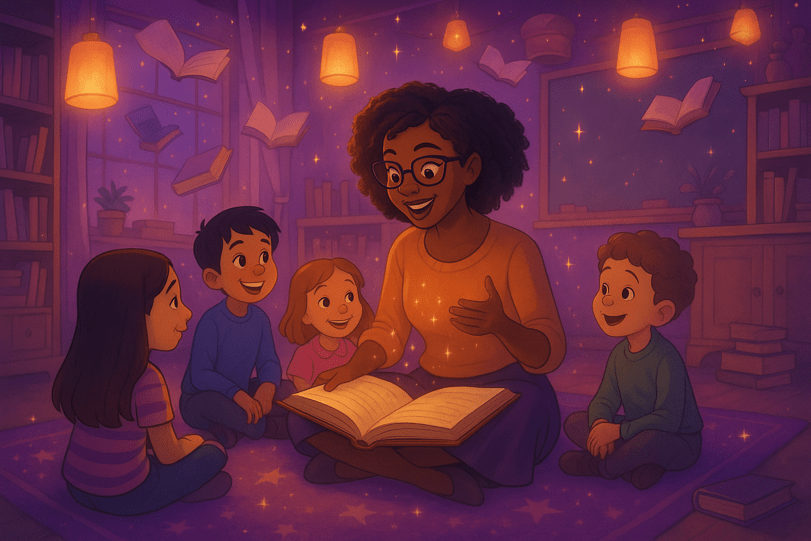
    Stories help bridge that gap. When I tell a story, especially one tied to our lesson, they step into a world filled with drama, humor, pain, curiosity, and humanity. It’s no longer just content, it’s a narrative!

    Think of the emotional magic behind a great Disney movie. Why does it stick with us? Because it stirs three powerful emotions: drama, humor, and empathy.

    Drama

    Drama isn’t about gossiping about your cousin’s chaotic wedding. It’s about emotional stakes. If I want students to grasp the seriousness of predatory lending, I might tell them the story of a naive college student (who may or may not be me) sitting down in a cold, institutional office with a financial advisor, overwhelmed and afraid, signing a document they barely understood. The fear. The regret. The consequences. That’s drama!

    Humor

    Humor is the gateway. We all want to be the classroom comedian, but a good story uses humor sparingly and strategically. Instead of aiming for roaring laughter, shoot for a smirk, a chuckle, a knowing smile. Disney excels here! Think of Olaf from Frozen or my personal favorite, Kronk! Whimsy is a great way to connect with our students. Connection with humor always helps defeat the dragon of classroom chaos.

    Empathy

    Empathy is the soul of storytelling. It’s the journal of a WWI soldier saying goodbye to his love. It’s the inner world of a student hiding insecurity under brash behavior. When we show students that we care about the content we teach, about the world we inhabit, and especially about them, they will respond!

    Empathy doesn’t mean preaching. It means positioning yourself as a human being who thinks and feels deeply, even if your values don’t always align exactly with theirs.

    This is why storytelling matters. Not to indoctrinate, but to illuminate. Not to say “Here’s what to believe,” but rather, “Here’s where I stand, and here’s why it matters to me.” That’s what Disney stories do. They don’t demand we believe, they invite us to feel.

    Students may not always agree with us. That’s okay! But when we share ourselves authentically, when we humanize our lessons, we create a space where students can better understand why we teach, why our lessons matters, and why we care. And that, more than any textbook definition, is what they’ll carry with them.

    So tell your stories. Not for the applause. Not for the control. But for the connection! Because behind every great lesson, there’s a story waiting to be told.

    Walt Disney himself once said, “I would rather entertain and hope that people learned something than educate people and hope they were entertained.” This might sound counterintuitive to everything I just said, but remember how he entertained us: with imagination, creativity, and artful skill. 

    Stay magical! 

  • Rethinking Wonder in Education

    Rethinking Wonder in Education

    Why I started Teaching With Disney

    As a high school history teacher in a small district, I’ve noticed something tragic as I watch students grow and develop:

    Many begin to lose their inner child.

    This isn’t to say that all students are depressed, angry, or visionless. Quite the opposite — many of them mature beautifully. They’re learning to tune in to their emotions. They’ve got dreams, even if those dreams are still forming like outlines on a foggy mirror. They’re not broken. But something is fading.

    When they step into our classrooms, those four walls usually feel like one of two things:

    • tolerable station on the way to something better
    • Or a prison cell with fluorescent lighting and assigned seating

    From day one in the classroom, I’ve asked myself:

    “How can we make learning magical again?”

    “How can we make it feel like wonder is still possible?”

    🎓 The Purpose of This Blog

    • ✨ Understand the power of storytelling in the classroom
    • 🧠 Apply true and tested methods of narrative education
    • 🎵 Incorporate music as a tool for emotional and intellectual learning
    • 💡 Create lesson plans that inspire, not just instruct

     But Why Disney?

    You might be asking: “Okay,… this all sounds poetic and nice, but what does this have to do with Disney?”

    To be honest?

    Why not Disney?

    Like most people breathing on planet Earth today, I’ve been shaped — deeply — by the power, creativity, and emotional intelligence of Disney films and music. These stories raised mechallenged me, and at times, healed me.

    As someone who only experienced the parks as an adult, I can tell you:

    The magic? It’s real.

    The joy? It’s palpable.

    The immersion? It’s life-changing.

    And while I don’t pretend to be an expert on every corner of the Disney universe, I do know this:

    I understand how storytelling works.

    It is my dream to see teachers everywhere embrace the art of:

    • Narrative
    • Drama
    • Atmosphere
    • Emotional connection

    …and use those tools to build classrooms that feel less like lecture halls and more like living stories.

    Storytelling, Culture, and the Human Spirit

    Just imagine:

    • Helping students step into another culture as seamlessly as we step into the glowing world of Pandora through VR.
    • Using a 5-minute clip from The Hunchback of Notre Dame to explore medieval heresy, power structures, and the Inquisition.
    • Analyzing Zootopia to discuss bias, systems, and social reform — in a way that connects, not lectures.

    Wouldn’t that be more powerful than a worksheet?

     The Goal

    Let me be clear:

    The goal of this blog is not to simply create a mini lesson plan for every Disney film.

    It’s also not just for history teachers (though I am one, and I’ll probably sneak in plenty of historical goodies).

    The goal is to explore the content and methods of Disney — and other studios too — to bring something magical into our learning environments.

    Something emotionally intelligentculturally aware, and deeply human.

    This is the beginning of the journey. I don’t have all the answers. But I know this:

    Teaching doesn’t have to feel like a grind.

    Your classroom doesn’t have to feel like a cage.

    And your students don’t have to lose their sense of wonder.

    So let’s teach differently.

    Let’s teach with purpose.

    Let’s teach with magic.

    Let’s teach with Disney! 🎬